


The Wind Rises over Santa Cruz: A Saga Set in Sixteenth-Century Morocco


In a country torn apart by rivalries, ambition, and foreign presence, men emerge determined to reshape the destiny of the kingdom. Centered on Mohammed Echeykh and the Saadian rise, the novel unfolds as a sweeping fresco of war, power, faith, and fragile loyalties. In it, I explore the grey areas of Moroccan history, where grandeur, fear, calculation, and courage intersect. A rich and vividly alive Moroccan historical novel devoted to one of the most decisive periods of sixteenth-century Morocco.
A sweeping Saga at the heart of Atlantic Morocco
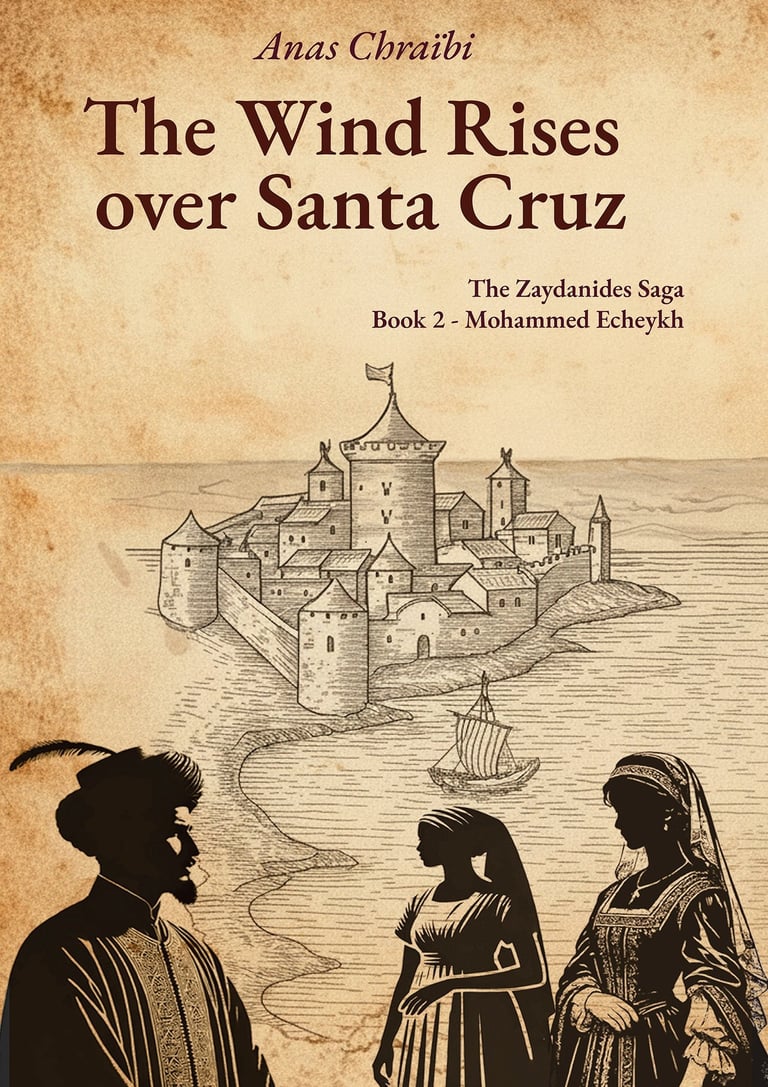
In this second volume, I continue my exploration of sixteenth-century Morocco, a decisive period that is still rarely represented in French-language historical fiction. The reader encounters a fragmented country, threatened along its coasts and riven by conflict, yet also shaped by great figures, complex political calculations, tribal loyalties, opposing visions of power, and individual destinies caught in the upheavals of history.
Mrs. Mouna Hachim:
From the very first pages, everything springs from an intimate wound. The initial murder is not merely political: it is a family betrayal, and above all the birth of a guilt that never truly disappears. From that point on, memory becomes almost an inward investigation. The novel does not simply trace the evolution of a country, but the making of a man, and with him the emergence of a religious power becoming political, moving from the household and the sacred toward public speech and then toward History itself: Akka, Tidsi, Fez, Marrakech, the Portuguese presence, the urban elites, a jihad that becomes strategy, a faith that also becomes an instrument of action…
The book never criticizes tradition; rather, it shows the precise moment when tradition ceases to be sufficient on its own to shape material reality. One moment seems decisive to me: the fall of the father. At that point, the narrator separates human authority from divine truth. It is the birth of an independent mind, and without that rupture he could never have acted. The novel thus advances a very powerful idea: authority is not always just. From that discovery are born revolt, commitment, but also tragedy. One constantly feels that the father belongs to a world still governed by sacred legitimacy, while the son must act in a universe where faith alone is no longer enough in the face of military and political powers.
Through this, a broader theme also emerges: the meeting of two historical logics. On the one hand, a universe grounded in honor, bravery, and sanctity; on the other, a world structured by technique, economy, and the long term. Neither is mocked nor glorified. History is simply changing scale, and men must learn to live within this new dimension.
The human figures give the book its depth. Rabia introduces a fragile balance, the possibility of loving, protecting, and building despite the pressure of fate. With Hassan al-Wazzan comes doubt: sanctity may be lived sincerely, but it can also be fashioned by collective belief. One understands that men sometimes need miracles even when they do not exist. The narrator’s consciousness then opens up, almost despite itself.
Sahaba struck me as central to this evolution. Where men think in terms of direct confrontation, she acts through observation and quiet transformation. She succeeds where bravery fails, and the novel gradually overturns its own values: patience becomes a form of courage, duration more decisive than immediate victory.
Ezzahra, for her part, introduces another dimension. She is neither the driving force of the action nor a strategist of power, but the silent measure of its consequences. Through her, history ceases to be abstract: what decisions build on one side, they erode on the other. She reminds us that political destiny is paid for not only in defeats or victories, but in displaced lives, impossible attachments, and irreversible losses.
The title then comes fully into its own. The wind rising over Santa Cruz is not war, but the circulation of knowledge, the end of closed worlds, the entry into a global history. It is no longer merely a local conflict, but a civilizational transformation.
What particularly interested me was the way the intimate dimension constantly accompanies history. As power grows, it becomes burdened with a moral debt. Victories do not elevate the characters; they weigh them down. Power appears less as an achievement than as a responsibility from which no one emerges unscathed. Violence itself ends up becoming almost abstract, while its human consequences—silence, solitude, the rupture between generations—become central. One feels that governing consists less and less in conquering and more and more in containing what force has set in motion.
It is impossible not to speak of the style. I was struck by the restraint of the writing, which remains limpid and free of grandiloquence, making the events more credible than spectacular. This sobriety suits the project well: it allows reflection to arise in the reader rather than imposing it, and maintains a distance that prevents any easy glorification. One follows the facts, but above all is led to measure their significance gradually.
At heart, I had the impression of witnessing the birth of a modern political consciousness in a still medieval world. The ending does not feel like a victory, but like an understanding: survival no longer depends solely on strength, nor even on faith, but on the ability to transform one’s way of thinking. The true defeat may not be to lose a kingdom, but to become a stranger to oneself. That is no doubt what gives the novel its particular depth: one does not merely witness episodes from the past, one understands how they become possible. History is not a backdrop; it is living matter, and the book succeeds in making perceptible that fragile moment when individual trajectories and the forces of time meet.
Taroudant and Sugar — A Trading City
The Sugar Industry in Saadian Morocco
Interview with Gérard Giuliato, professor at the University of Lorraine, on the history of sugar cane cultivation in Morocco between the 9th and 17th centuries. Summary of an article published in the online journal Yabiladi.
Origins and expansion: Initially cultivated on a small scale in the oases of the Anti-Atlas, sugar cane became a state industry under the Saadians from 1540 onward. After driving the Portuguese out of Agadir, the Saadian sharifs developed large state-run estates in order to export sugar on a massive scale to Europe, where it was highly prized.
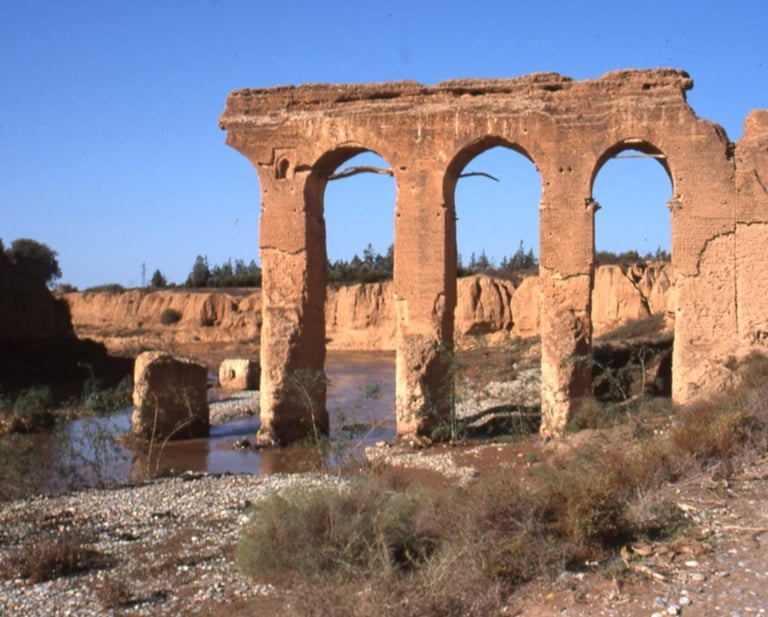
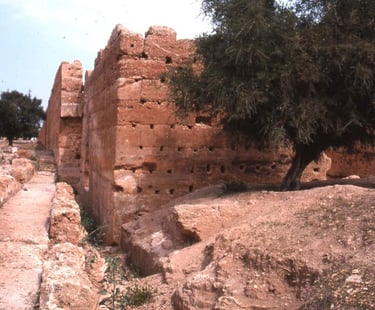
A technical feat: Moroccan sugar mills stood out for the scale of their hydraulic infrastructure—séguias, aqueducts, and reservoirs—which could extend up to 2,400 meters in length and were built in rammed earth by a local workforce. Unlike the Americas, this industry did not rely on African slave labor.
A driver of political power: Sugar revenues enabled the Saadians to finance their army, modernize the state, build great palaces, and withstand Portuguese, Spanish, and Ottoman pressure, while also extending their influence as far as Timbuktu.
The decline: The death of Ahmad al-Mansur, followed by civil wars and epidemics, destabilized the system. Peasants stopped performing forced labor and looted the installations. From 1620 onward, competition from cheaper Caribbean and Brazilian sugar brought this industry to a definitive end.
A threatened heritage: Today, these sites are poorly protected and are being steadily eroded by urban expansion and intensive agriculture, despite their unique character on a world scale.
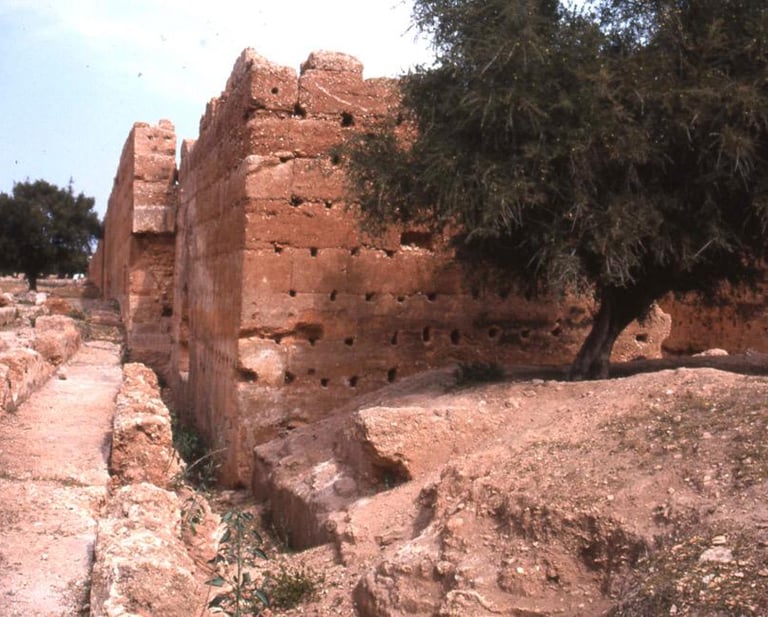
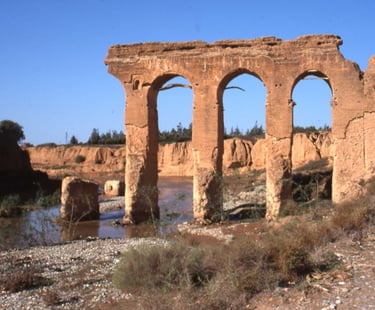
Aqueduct over Oued Ouaaer. Credit: Yabiladi
Housing for the Waterwheel and tailrace channel. Credit: Yabiladi