A Review of My Favorite Reads
Harems et Sultans - 3 volumes
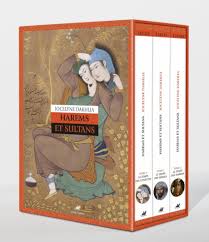
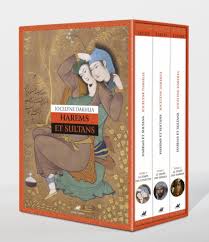
Reading a work this dense and erudite is not within everyone’s reach. As I began the first volume, I quickly understood that I would need a faithful companion: a dictionary, which I never let go of. “Tropism,” “aulic”… so many refined and necessary terms that I had to tame as I went along. But it was well worth the effort.
In this remarkable work, spread across three volumes of 600 pages each, Jocelyne Dakhlia tackles a subject that is as fascinating as it is little known: the women of the harems in the Arab world, and more particularly in the Maghreb, especially in Morocco. Everything begins with a troubling story: that of the death of a sultan’s wife during a crossing of the snow-covered Atlas Mountains. Intrigued, the historian brings all her scholarly rigor to bear in tracing the threads of a forgotten history.
As the pages unfold, she brings to life a gallery of vivid, sometimes unsettling figures, such as Prince Abdelmalek, who, in the early seventeenth century, indulged in torturing his subjects after drinking too much. With subtlety and courage, Jocelyne Dakhlia dismantles the myths conveyed by Ottoman narratives and by the famous “Sultanate of Women” of Topkapi. For in the palaces of the Maghreb, the gynaecea were not the silent prisons we too often imagine; on the contrary, they were filled with echoes of the outside world, far less sealed off than has long been assumed.
Another myth she dismantles is the supposed natural superiority of the white race over the black race. Racism does not appear here as something natural, but rather as a wholly human construction. Whites and Blacks, Christians, Muslims, and Jews live together, kill one another, love one another, without skin color seeming in itself to determine human relationships. Slaves and eunuchs alike are as often white as black.
The sources on the women of the harems, whether noblewomen or women of common origin, are scarce, fragmentary, almost whispered. And yet Dakhlia performs a real tour de force by gathering, with remarkable meticulousness, everything that has been written or transmitted about them. The result is a major work, demanding and abundant, one that nourishes both the imagination and knowledge. It is a gold mine for any novelist passionate about history, offering material that is as precious as it is alive;
One fact that struck me: Jocelyne Dakhlia was among the signatories, along with a collective of intellectuals, of a column published in Le Monde in February 2016, entitled: “Cologne Night: ‘Kamel Daoud recycles the most hackneyed orientalist clichés.’” Kamel Daoud later received the 2024 Prix Goncourt for his novel Houris.
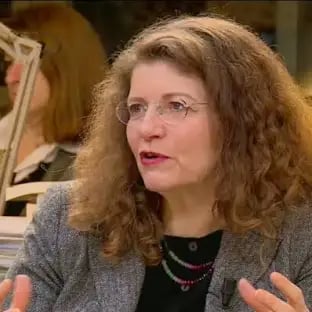
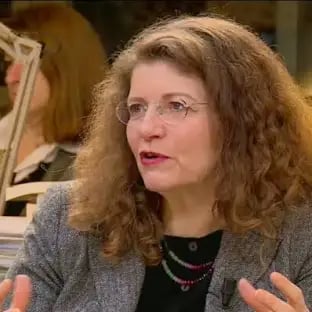
Jocelyne Dakhlya
Née en 1959 à Bourg-en-Bresse, est une historienne et anthropologue franco-tunisienne.
Directrice d'Etudes à l'IHESS
Anacharsis Editions
Jocelyne Dakhlya
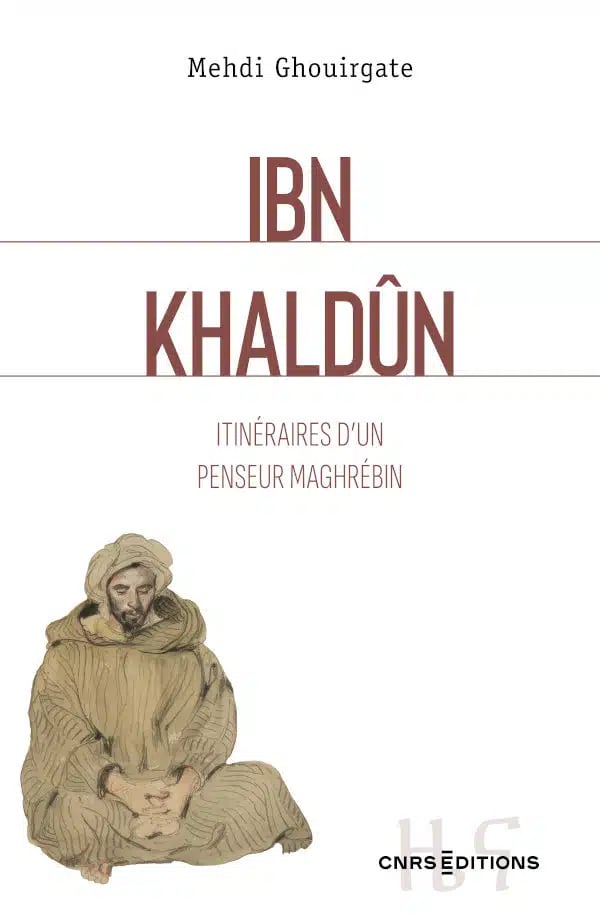
Ibn Khaldoun- Itinéraires d’un penseur maghrébin

Since his rediscovery in Europe two centuries ago, the fame of Ibn Khaldūn (1332–1406) has continued to grow, to the point that he is now the only intellectual from the Arab-Muslim world to enjoy a truly universal readership. The author of the monumental Kitāb al-‘ibar, or Book of Lessons, has been compared to the great names of Antiquity and the modern age, from Thucydides to Machiavelli, from Montesquieu to Marx. In this way, he has earned his reputation as a forerunner of modern thinkers of society, the state, and the economy.
Going beyond the romantic image of the solitary “genius,” this study seeks to reconstruct Ibn Khaldūn’s trajectory during a period marked both by the Black Death and by the failure of the Marinid sultan Abū l-Hasan (r. 1333–1348) to unify the Maghreb. It retraces the wanderings of a man who was first a practitioner of power in the courts of the Muslim West—Tunis, Fez, Granada, Béjaïa, and Tlemcen—before his exile to Cairo, then the most brilliant city of Islam, where he devoted himself to teaching and to a career as a magistrate. In this way, the book sheds vivid light on the conditions in which his theory of civilization took shape, while also inviting reflection on how he came to be constructed as a figure of the philosophy of history, first in Muslim worlds and later in the West.
This highly readable book is a must for anyone who wants to understand Ibn Khaldūn.
Professor at Bordeaux Montaigne University and associate professor at Mohammed VI University in Rabat,
he has notably published Les Empires berbères: constructions et déconstructions d’un objet historiographique (2024).
CNRS Éditions
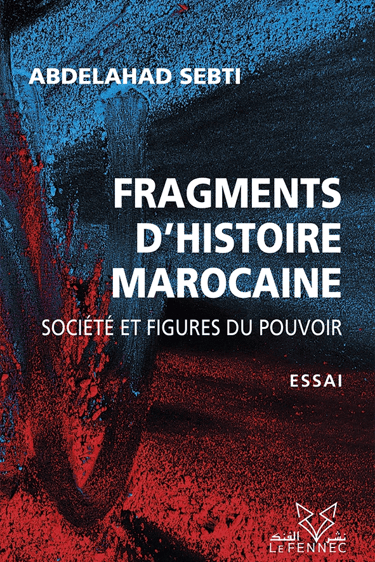
Fragments d'histoire marocaine


Abdelahad Sebti is a delightful figure—modest, attentive to others, and highly learned. He always offers an original perspective. This work is short and easy to read, yet at the same time it is a mine of information. The subjects it addresses belong to different periods, from the “Middle Ages” to the twentieth century, and together they offer a living history, at times deeply captivating. The perspectives shift constantly in scale: a specific event, an individual, a family, a social group, an institution, a myth, or a field of research. At times, one also moves between local history and national history. And clearly, each article can be read separately: readers may choose the sections that speak to them at one level or another. The themes brought together in this volume offer angles of observation that illuminate broader phenomena, and all these phenomena converge on the question of the relationship between society and power. What we have here, then, is a social history of power that renews our understanding of Moroccan society and the Moroccan state in their historical dimension.
Abdelahad Sebti
Professor at Mohammed V University in Rabat, Abdelahad Sebti is a historian open to anthropological and literary approaches. He has worked in particular on genealogical culture, tea, and the insecurity of travel in precolonial Morocco. His recent work, Min Am al-fil ilá Am al-Márikãn (2022), deals with the relationship between oral memory and historiographical tradition.
Le Fennec Editions